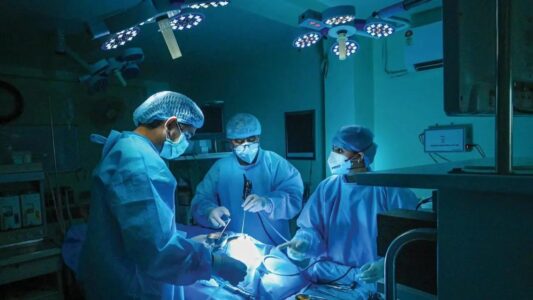
Mumbai doctors at a city hospital have successfully performed a complex and extraordinary liver surgery on a two-year-old giving the child a new lease of life.
Aphsa, was diagnosed with an advanced liver cancer involving major blood vessels in and around the liver. The cancer was inoperable by conventional surgery, leading to the innovative operation led by Dr Abhishek Mathur, with the collaborative expertise of Prof Darius Mirza, Dr Pradnya Bendre, Dr Shailesh Sable, Dr Gayatri Munghate, and Dr Saurin Dani, turning what seemed like an impossible situation into a story of hope.
Aphsa, who is a cheerful and lively child, was diagnosed with a locally advanced hepatoblastoma by oncologist Dr Mudaliar after her mother noticed a swelling in her abdomen. Hepatoblastomas represent one of the commonest liver cancers in children. However, when they are central in their location within the liver, they can prove to be a difficult surgical challenge on account of the involvement of important blood vessels in and around the liver.
Following diagnosis, initial chemotherapy led to some tumour reduction, but conventional surgery was still not feasible due to the tumour’s location and its involvement of vital blood vessels. Liver transplantation would have been the treatment of choice, but the absence of a donor (living or deceased) organ during the short critical window following chemotherapy made this unavailable. Despite shrinkage with chemotherapy, the tumour still completely obstructed blood outflow from the liver, necessitating total liver removal and extensive vessel reconstructions, not possible by standard surgical approaches.
Dr Mathur, who is the chief division of Liver Transplant and Hepatobiliary Surgery at Bai Jerbai Wadia Hospital for Children, explains, “The baby’s liver was small, weighing around 500 grams and we planned to take the liver out of the body intact. This rare Ex-situ (out of the body) surgical technique involves removal of the entire liver from the child’s body, followed by cooling and preservation of the organ outside the body for 4.5 hours. This approach gives unparalleled exposure and access to remove the tumour-affected liver and perform a meticulous reconstruction of the blood vessels. Once completed, the reconstructed remaining healthy liver segment is auto-transplanted back into the body. Despite these benefits, this approach is also associated with higher perioperative morbidity and mortality rates on account of liver injury while it is out of the body. To mitigate these risks, we used the novel technique of ex-situ oxygenated hypothermic machine preservation, which perfuses and cools the liver outside the body, resulting in reduced liver injury.”
He further added, “This method of ex-situ surgery using oxygenated hypothermic machine perfusion is rarely described for liver cancer, and to the best of our current knowledge, never reported in children in this situation. Ex situ surgeries are regularly performed at only a handful of specialized centers in North America, and even at these advanced institutions, the procedure is carried out just a few times each year due to its complexity and highly selective indications. To give context to how rare this operation is, the existing medical literature includes only one published adult case where ex situ surgery was combined with hypothermic machine perfusion. To the best of our knowledge, this has never been done in India. We plan to publish our data and have it peer reviewed to determine whether this approach has been attempted anywhere else in the world.”
Describing the operation, Mirza, professor of Surgery and mentor of Division Of Liver Transplant and Hepatobiliary Surgery said, “A highly coordinated effort was crucial to the success of the surgery. After the removal of the entire liver, two teams of surgeons worked in tandem. While one team removed the tumour from the liver and reconstructed the healthy remaining liver, while it was being preserved on the hypothermic machine, the other team performed a complex reconstruction of the major blood vessels inside the child’s body.”
Dr Bendre, head of Solid Organ Transplant and Head of Pediatric Surgery added, “Aphsa’s surgery greatly benefited by access to the perfusion machine, which was generously provided free of charge by the “Duraent Lifesciences, ensuring that Aphsa’s underprivileged family could take advantage of this life-saving technology.”
“Aphsa’s surgery lasted 14 hours, and the use of the hypothermic machine prevented her from suffering liver damage. She made an excellent recovery, with the vigilance of our anesthesia and intensive care teams, and was moved out of the ICU within the first postoperative week and discharged home about a week later. While Aphsa will require further chemotherapy and close surveillance for tumour recurrence rates, which can reach 10-30% in such advanced cases, her parents are profoundly grateful for her renewed chance at life,” said Dr. Abhishek Mathur.
“When we were told how serious our child’s condition was, our world collapsed. Every day was filled with fear, and we did not know if she would survive. This innovative procedure was something we had never even heard of, but it became our only hope. Today, seeing our daughter smile again and dream of a bright future feels nothing short of a miracle. While she still has challenges ahead, we will always be grateful to the doctors who gave her the chance at life,” said her elated father Saddam Hussain Shaikh.
“Auto-transplantation, where a child’s own healthy organ is returned to the body after treatment, can be a powerful life-saving option, turning medical innovation into hope for families. At Bai Jerbai Wadia Children’s Hospital, we remain deeply committed to bringing advanced medical technology and global expertise together to ensure that no child is denied a chance at life,” concluded Dr Minnie Bodhanwala, CEO of the city hospital.
Mumbai docs give two-year-old child new lease of life with complex liver surgery