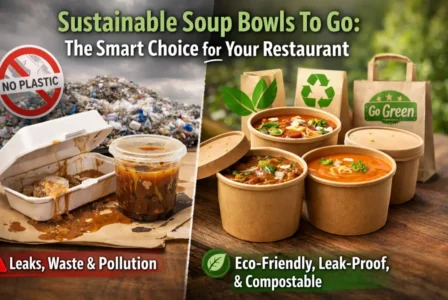
Today`s diners aren`t just ordering food—they`re voting with their wallets for businesses that share their values. Sustainability has moved from a nice-to-have to a must-have, especially in the restaurant industry. Yet while many establishments have upgraded their practices, one persistent challenge remains: packaging takeout soups, stews, and other liquid-heavy dishes without creating environmental waste or operational headaches. Traditional plastic and styrofoam containers continue to dominate this space, but they come with serious drawbacks. They leak during transport, fail to keep food at the right temperature, contribute to mounting landfill waste, and increasingly signal to customers that a restaurant hasn`t kept pace with modern expectations. The solution isn`t complicated. Switching to purpose-built, sustainable soup bowls represents a strategic decision that simultaneously addresses environmental responsibility, enhances customer satisfaction, and streamlines your operations. This isn`t about following a trend—it`s about future-proofing your business while solving real problems that affect your bottom line and reputation every single day.
The Problem with Traditional Take Out Food Boxes for Soups & Stews
Traditional plastic and styrofoam containers create a cascade of problems that directly impact your restaurant`s operations and reputation. Leakage tops the list of customer complaints—soups seeping through bag seams or lids popping off during transit generates immediate negative reviews and refund requests. These containers simply weren`t engineered for liquid foods, yet restaurants continue using them because they`re familiar and cheap upfront. The insulation performance is equally problematic. Styrofoam may retain some heat, but plastic containers allow soups to cool rapidly, meaning customers receive lukewarm meals that don`t represent your kitchen`s standards. Beyond functionality, the environmental toll is staggering. These materials persist in landfills for centuries, and styrofoam breaks into microplastics that contaminate ecosystems. Customers notice when their takeout generates excessive waste, and it shapes their perception of your brand values. The regulatory landscape is shifting too—cities and states are implementing bans on polystyrene foam and certain single-use plastics, forcing restaurants to scramble for compliant alternatives. Continuing with outdated packaging isn`t just environmentally irresponsible; it`s a business liability that exposes you to customer dissatisfaction, potential fines, and the reputation of being behind the curve while competitors advertise their sustainable practices.
Beyond the Bowl: The Comprehensive Benefits of Eco-Friendly Packaging
Adopting sustainable soup bowls creates a ripple effect that extends far beyond a single menu item. Once you`ve identified effective compostable containers for liquids—arguably the most challenging packaging category—you`ve essentially road-tested solutions that can work across your entire takeout operation. Many restaurants discover that the same molded fiber or lined paperboard bowls handling hot soups perform equally well for grain bowls, salads, and entrées, allowing you to consolidate inventory around a smaller selection of versatile, eco-friendly containers. This streamlines ordering, reduces storage space, and simplifies staff training. The marketing value is substantial and immediate. Today`s consumers actively seek out restaurants that demonstrate environmental responsibility, and your packaging is the most tangible proof of that commitment. When customers receive their order in compostable containers, they`re holding physical evidence that you share their values—something that translates directly into loyalty, positive reviews, and word-of-mouth recommendations. You can leverage this switch across all customer touchpoints: website copy, social media announcements, in-store signage, and even printed messages on the containers themselves. The perception shift is real—premium sustainable packaging elevates the entire dining experience, making your food feel more carefully considered and higher quality. Customers subconsciously associate thoughtful packaging with thoughtful cooking. There`s also a growing segment of corporate clients and catering customers who specifically require sustainable packaging for events, opening revenue streams that were previously inaccessible. While the per-unit cost of eco-friendly containers may initially appear higher than conventional plastic, the total cost equation changes when you factor in waste hauling fees (many municipalities charge less for compostable waste), the ability to justify slightly higher menu prices for sustainably packaged items, reduced refunds from packaging failures, and the long-term customer lifetime value gained through enhanced brand reputation. Sustainable packaging isn`t an isolated decision—it`s a strategic foundation that supports premium positioning, operational efficiency, and genuine differentiation in an increasingly crowded market.
Your Practical Guide to Choosing the Right Sustainable Soup Bowls
Step 1: Assess Material Options (Compostable Containers Deep Dive)
Understanding your material choices is fundamental to selecting containers that actually perform. Molded fiber, typically made from bagasse (sugarcane pulp) or bamboo, offers excellent heat tolerance and structural strength, making it ideal for hot soups and stews. These containers handle temperatures up to 200°F without warping and provide natural insulation. The texture feels substantial to customers, but unlined versions can become soggy with extended contact with liquids—look for variants with plant-based moisture barriers. PLA (polylactic acid) containers, derived from corn starch, resemble traditional clear plastic and work well for cold or room-temperature soups, but they soften above 120°F, making them unsuitable for piping-hot liquids. Their transparency does showcase colorful soups attractively. Recycled paperboard bowls with bioplastic linings combine familiar aesthetics with functionality—the inner coating prevents leaks while the paperboard provides insulation and rigidity. The critical distinction across all these materials is certification: commercial compostability (requiring industrial facilities) versus home compostability. Most compostable containers need commercial composting to break down properly, so verify what waste infrastructure exists in your area and communicate this clearly to customers to avoid confusion.
Step 2: Prioritize Functionality for Security and Freshness
A sustainable bowl that leaks defeats the entire purpose, so functionality must drive your selection. Lid security is non-negotiable—test whether lids require a firm snap that you can hear and feel, indicating a proper seal. Vented lids allow steam to escape gradually, preventing condensation that makes food soggy, but ensure vents are designed to prevent spills during transport. Temperature retention directly affects customer satisfaction; double-walled containers or those with air-gap insulation keep soups hot for 45-60 minutes, which covers most delivery windows. Structural integrity under stress matters more than you`d expect—containers must maintain their shape when stacked, carried in bags, or held by one hand. Fill a sample container with hot liquid, seal it, shake it gently, let it sit for 30 minutes, then transport it in a typical delivery bag. This real-world test reveals whether the container will perform during actual service. Size accuracy is equally important; your 12-ounce soup portion needs a container with appropriate headspace—too much empty space looks cheap and allows excessive sloshing, while overfilling guarantees leaks. Order samples in multiple sizes and conduct side-by-side comparisons with your actual menu items before committing to bulk purchases.
Step 3: Source Reliable Suppliers and Calculate True Cost
Supplier reliability determines whether your sustainable packaging strategy succeeds or creates new operational headaches. Prioritize suppliers who provide third-party certifications like BPI (Biodegradable Products Institute) or TUV Austria, which verify compostability claims—greenwashing is rampant in this space. Request certificates of analysis and ask about their supply chain consistency; the last thing you need is a sustainable container that`s perpetually out of stock. Major tableware suppliers like Jolly Chef have expanded their product lines to include certified compostable options alongside traditional offerings, making it easier to source sustainable containers through established vendor relationships. Calculate true cost beyond the unit price by creating a comprehensive comparison. Factor in your current waste hauling fees (many waste management companies charge 30-40% less for compostable waste streams), the reduction in refunds and remakes from packaging failures, and the premium pricing opportunity sustainable packaging creates. If switching allows you to add even fifty cents to your soup prices without customer resistance, that margin change often exceeds the per-unit cost difference. Consider volume discounts and storage requirements—sustainable containers sometimes require more space than compressed plastic stacks. Request net-30 payment terms from suppliers once you`ve established reliability, improving your cash flow. Finally, build relationships with 2-3 certified suppliers rather than relying on a single source, protecting yourself against supply disruptions while maintaining negotiating leverage on pricing.
Implementing and Marketing Your New Sustainable To-Go System
Successfully transitioning to sustainable soup bowls requires more than just ordering new containers—you need a deliberate rollout strategy that maximizes operational smoothness and marketing impact. Start with staff training at least one week before launch. Walk your team through the proper sealing technique for new lids, emphasizing the firm snap or press required for leak-proof closure. Explain the environmental benefits in simple terms so servers can confidently answer customer questions; when staff understand why the change matters, they become authentic ambassadors rather than reluctant participants. Update all customer-facing materials simultaneously to create consistent messaging. Add a brief callout on your website menu: “Now serving in 100% compostable containers” with a link to a short explanation page. Contact your third-party delivery platform representatives to update your restaurant profile with sustainability badges or descriptions—many platforms now feature filters for eco-conscious restaurants. Simple in-store signage near the pickup counter works remarkably well; a small tent card stating “These containers are commercially compostable—thank you for supporting our commitment to sustainability” educates customers at the moment they receive their order. Leverage the switch for content marketing by documenting the transition on social media with behind-the-scenes photos of your new packaging, brief videos explaining the materials, and posts inviting customers to share their experience with your new containers. Local media often covers sustainability initiatives, so send a simple press release to neighborhood publications and food bloggers. Finally, actively solicit feedback during the first month through comment cards, follow-up emails, or social media polls asking specific questions: “Does your soup arrive hot?” and “How do you feel about our new compostable containers?” This feedback loop helps you identify any functional issues early while demonstrating to customers that their opinion shapes your decisions, deepening their connection to your restaurant`s evolution.
Making the Strategic Switch to Sustainable Packaging
Sustainable soup bowls represent far more than a packaging upgrade—they`re a strategic investment that positions your restaurant for long-term success in an evolving marketplace. By making this switch, you simultaneously address three critical business objectives: reducing your environmental footprint and meeting regulatory requirements, elevating your brand reputation among increasingly conscious consumers, and improving the functional quality of your takeout experience through containers specifically engineered for liquid foods. The initial transition requires deliberate planning and modest upfront investment, but the returns manifest quickly through enhanced customer loyalty, reduced operational problems from leaks and complaints, and the ability to authentically market your commitment to sustainability. The restaurants thriving today aren`t those clinging to outdated practices because they`re familiar or marginally cheaper—they`re the ones recognizing that customer values have fundamentally shifted and responding with tangible changes customers can see and touch with every order. Start by auditing your current takeout packaging, identifying which items generate the most complaints or waste, and requesting samples from certified sustainable suppliers. The gap between intention and implementation is simply one decision: choosing containers that reflect the quality of your food and the values of your community. Your customers are ready for this change—the question is whether you`ll lead or follow.
Why Your Restaurant Needs Sustainable Soup Bowls To Go